Typing Drills
Home Row Typing Exercises for ASDF and JKL
Master the home row keys ASDF and JKL; to build accurate touch typing habits. Follow our progressive drills, finger assignments, and diagnostic tests.
By ProTypingGames ·
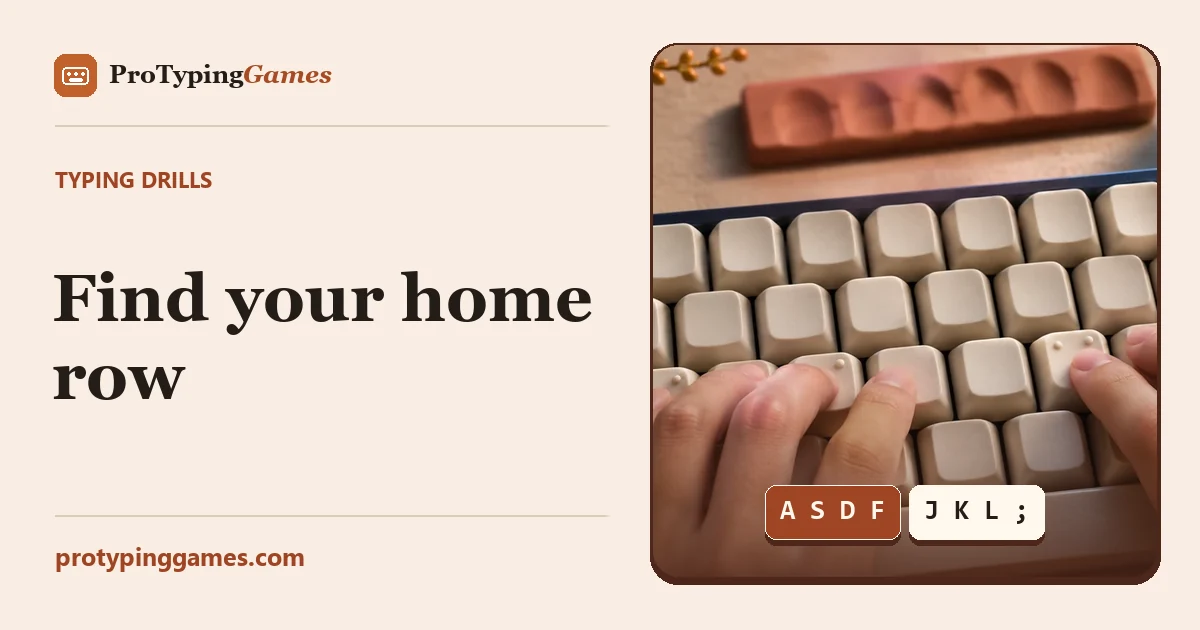
To type accurately on a US QWERTY keyboard, rest your eight fingers across the middle letter strip: A, S, D, and F for the left hand, and J, K, L, and the semicolon key for the right hand. This center setup is the home row, and every touch typing pattern builds outward from this single baseline.
When you master these eight baseline keys, you eliminate the visual search for individual letters. Your hands stay oriented around physical reference points, allowing your fingers to strike nearby rows and return automatically without breaking your typing rhythm.
Finding your finger anchors
Before typing a single drill, place your hands into their starting positions. The index fingers serve as your anchors. Look closely at your physical keyboard to spot the raised plastic bumps or ridges on the F and J keys.
Your left index finger rests on F, and your right index finger rests on J. These tactile markers let you confirm your hand placement entirely by touch. From those two anchors, settle your remaining fingers along the middle row.
The left hand sits across four distinct keys:
- Pinky finger: A
- Ring finger: S
- Middle finger: D
- Index finger: F
The right hand covers the mirrored side:
- Index finger: J
- Middle finger: K
- Ring finger: L
- Pinky finger: ; (semicolon)
Both thumbs rest gently on the spacebar. Keep your wrists hovering slightly above the desk rather than planting them firmly on the desk surface. Hovering allows your fingers to strike each key from above with minimal joint strain.
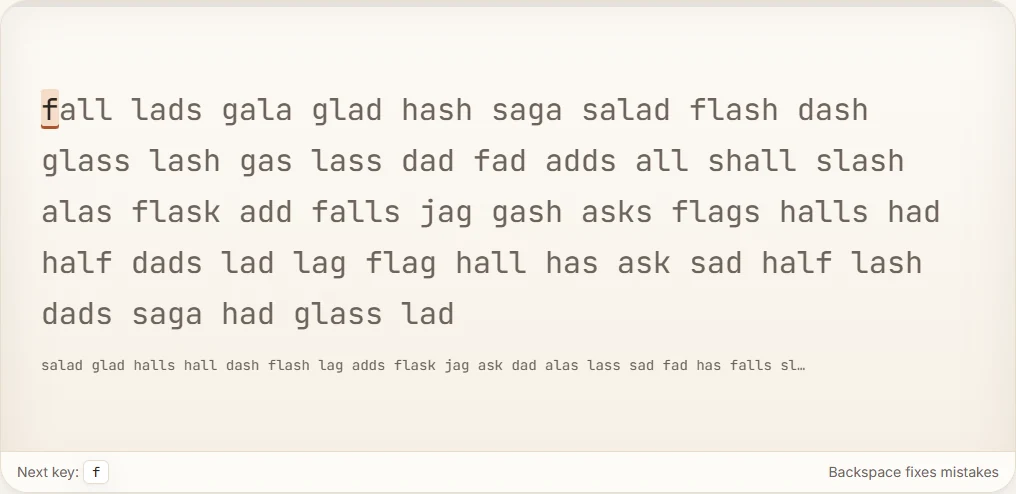
If you want a structured progression that introduces these keys step by step, you can play Home Row Hero to practice baseline coordination before expanding to the outer keyboard rows.
Single-hand isolation drills
Begin your practice by isolating each hand. Working one hand at a time trains each independent finger to press its assigned key without triggering movement in the adjacent fingers.
Type each line slowly. Tap the spacebar with your dominant thumb after each four-letter cluster. Focus on crisp, individual strikes without resting heavy weight on inactive keys.
Left-hand isolation set
aaaa ssss dddd ffffasdf asdf asdf asdffdsa fdsa fdsa fdsaaass ddff aass ddffasfa afsa dsfa fasdffdd ssff aass ddfa
Right-hand isolation set
jjjj kkkk llll ;;;;jkl; jkl; jkl; jkl;;lkj ;lkj ;lkj ;lkjjjkk ll;; jjkk ll;;j;lj j;kj lk;j ;lkj;;ll kk;; jjll kk;;
Repeat each isolation line three times. If an unassigned finger twitches or presses down alongside the target finger, pause and reset your hand on the F and J anchor marks before continuing.
Alternation patterns
Alternating strokes between your left and right hands balances keyboard workload and establishes steady typing cadence. When you alternate hands, one hand prepares its movement while the opposite hand strikes.
Type through these paired clusters. Maintain a steady, metronome-like tempo across every keystroke:
aj sk dl f; aj sk dl f;f; dl sk aj f; dl sk ajak sl d; fj ak sl d; fjfa js kd l; fa js kd l;a; sl dk fj a; sl dk fjfjdk sla; fjdk sla; fjdkjfkd lsa; jfkd lsa; jfkdask; dljf ask; dljf ask;
Notice how your thumbs handle spacing between words. Decide whether you prefer using your right thumb or left thumb for the spacebar, and stick to that single thumb throughout alternation practice to keep your hand rhythm consistent.
Same-hand repeats and skip intervals
In everyday English, words often demand quick, consecutive strikes from fingers on the very same hand. Practicing same-hand skips trains your ring fingers and pinkies to fire independently without dragging the middle finger along.
These drills force your fingers to skip intermediate keys within a single hand:
adaf adaf sfsd sfsdjlj; jlj; k;kj k;kjasaf sdfs adfs fsdajklj kl;k j;lk ;ljkafds j;lk afsd j;klasdf;lkj afsd j;klaaff ssdd jj;; kklldfsa ;lkj fds; jkla
Pay special attention to the skip between the pinky and the middle finger (ada or ;l;). Ring fingers naturally share tendons with middle fingers, so these combinations require focused muscle control.
Real words on the home row
Once individual finger movements feel predictable, transition to real English words formed entirely from the home row keys. Practicing real words helps your brain process letter groups as single muscular sequences rather than isolated characters.
Three-letter home row words
add all ask dad fad fall fas lad sadask dad all fad lad add sad ask dadfad all sad add ask dad fall lad all
Four-letter and five-letter home row words
adds fall flask lads lass salsa saladflak daffy falls salad salsa flask addsalas fads dads salads flasks fall lass
Short home row sentences and phrases
Use the semicolon to end phrases just as you would in structured punctuation drills:
a dad asks a lad;a lad asks a dad;sad dads fall;all lads ask dad;a flask falls;dad adds salads;a sad lass asks dad;fall salads fill flasks;all dads add salsa;
Type each phrase smoothly from start to finish. Keep your eyes on the text prompts on screen rather than looking down at your physical keys. If you want to check your progress on these foundational letter sequences, you can take a baseline home row typing test to measure your clean keystrokes across the middle row.
Diagnosing a weak finger
Most typists struggle with uneven finger strength. Pinky and ring fingers typically exhibit lower speed and control than index and middle fingers. You can identify your exact weak points through structured mechanical observation.
Step 1: Run the isolated digit test
Type thirty consecutive repetitions of each single character without spaces:
- Left pinky:
aaaaaaaaaaaaaaaaaaaaaaaaaaaaaa - Left ring:
ssssssssssssssssssssssssssssss - Left middle:
dddddddddddddddddddddddddddddd - Left index:
ffffffffffffffffffffffffffffff - Right index:
jjjjjjjjjjjjjjjjjjjjjjjjjjjjjj - Right middle:
kkkkkkkkkkkkkkkkkkkkkkkkkkkkkk - Right ring:
llllllllllllllllllllllllllllll - Right pinky:
;;;;;;;;;;;;;;;;;;;;;;;;;;;;;;
Step 2: Evaluate physical symptoms
While typing each string, note whether you experience:
- Hesitation before initiating the finger strike
- Unintended double presses (key bouncing)
- Tension pulling your wrist downward
- Sympathetic movement, such as the pinky curling upward when the ring finger strikes
Step 3: Apply targeted corrective drills
If your weak point is the left ring finger (S), isolate it against its neighbors:
as sa ds sd asds sdas asas ssds
If your weak point is the right pinky finger (;), practice edge extensions:
l; ;l k; ;k j; ;j l;k; ;lj; ;;;;
If your weak point is the left pinky finger (A), drill outward expansions:
af fa ad da as sa aads afsa aaaa
If your weak point is the right ring finger (L), reinforce split transitions:
kl lk jl lj ;l l; kljl l;lk llll
Spending three minutes daily on corrective combinations balances the output force across all ten fingers.
How typing metrics are calculated
Understanding keyboard performance metrics helps you interpret your practice sessions cleanly. When you complete timed software tests, your scores are derived from specific character calculations.
Raw speed measures total mechanical volume. Retained typed character units are divided by 5, and that figure is divided by the test time in minutes:
Raw WPM = (Retained Characters / 5 ÷ Minutes)
Net speed measures only correctly produced text. Correctly matched character units are divided by 5, and that value is divided by the test duration:
Net WPM = (Correct Characters / 5 ÷ Minutes)
Attempt accuracy reflects precision across every single key strike:
Accuracy = ((Successful Attempts ÷ All Scored Attempts)) × 100
Worked scoring example
Suppose you complete a 60-second (1.0 minute) home row test. During the test, you produce 200 total retained characters. Out of those, 190 characters correctly match the target text, while 10 characters contain errors. Across the session, you made 210 total keystroke attempts because you corrected several missed entries along the way.
-
Calculate Raw WPM:
Raw WPM = (200 / 5 ÷ 1.0) = (40 ÷ 1.0) = 40 WPM -
Calculate Net WPM:
Net WPM = (190 / 5 ÷ 1.0) = (38 ÷ 1.0) = 38 WPM -
Calculate Accuracy:
Accuracy = ((190 ÷ 210)) × 100 ≈ 90.48% → 90%
Notice that fixing a mistake preserves your net character count in the final text stream, but the original mistyped attempt remains counted in your overall accuracy percentage. To build a comprehensive overview of how these foundational mechanics support full-keyboard mastery, explore our complete touch typing guide.
Comprehensive mixed drill set
Combine all eight keys into comprehensive practice blocks. These exercises mix single-hand strikes, alternating intervals, semicolon stops, and full-length words.
Work through each block at an even, controlled pace. Do not rush to complete lines quickly; focus on striking every character cleanly on the center of the keycap.
Mixed block 1
asdf jkl; a;sd jkfl asdf ;lkjfall lads; a flask falls; sad dad;dsaf j;lk fads ;lkj afsd j;klsalad; salsa; flask; daffy; fall;fa;l sdjk af;l sd;k fald sjak
Mixed block 2
ask a lad; add a salad; all dads ask;;;aa llss kkdd jjff ;a;a lksdflak lads; sad lass; a dad adds salsa;jfkd lsa; ;asl kdfj f;jd skladads ask lads; lads ask dads; fall;
Mixed block 3
a sad lad asks for a salad;flask; flak; fall; lads; lass; dads;salsa adds flak; a flask falls sad;asdf jkl; fdsa ;lkj a;sd kfljall fall; all ask; all add; all lads;
Mixed block 4
a; sl dk fj f; kd ls jalads add salsa; dads fall; sad lass;ffjj ddkk ssll aa;; fjdk sla;salad flask; all lads ask sad dads;asdf ;lkj fdsa jkl; a;sl dkf;
Establishing a structured home row routine
Practicing for ten focused minutes each day produces better muscle memory than practicing for an hour once a week. Set up a daily session using a clear four-part structure:
- Warm-up (2 minutes): Run through the single-hand isolation drills for both hands. Confirm your fingers naturally return to the F and J index bumps.
- Interval training (3 minutes): Work on same-hand skips and alternation sets. Focus on keeping your non-striking fingers relaxed.
- Word formation (3 minutes): Type real home row words and short punctuated phrases. Maintain steady spacing with your thumb.
- Diagnostic check (2 minutes): Identify your slowest or least consistent finger, and run two corrective strings to reinforce that digit.
Place your index fingers on the F and J tactile bumps right now, set a two-minute timer, and complete Mixed Block 1 without looking down at your keyboard.
Put it into practice
The fastest way to improve is to play. Jump into a free typing game and try it now.
Play free typing games