Typing Drills
How to Type Long Words Without Losing Your Rhythm
Master long word typing practice by breaking complex vocabulary into manageable chunks and building muscle memory to keep your rhythm steady.
By ProTypingGames ·
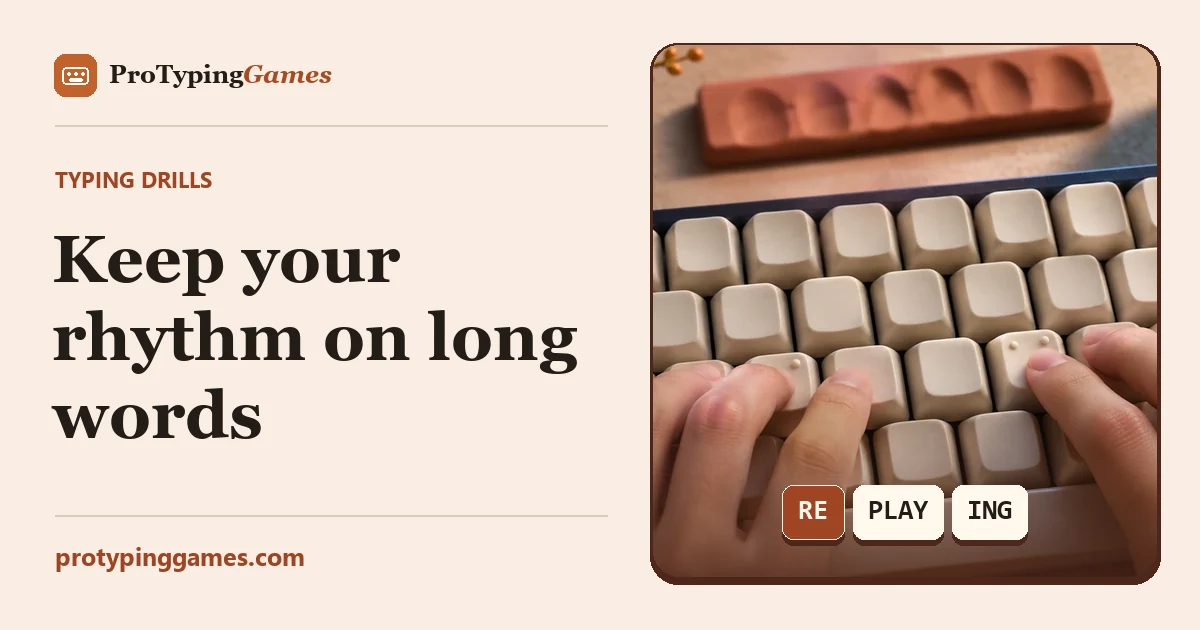
To type long words without losing your rhythm, you need to visually break them into smaller, familiar letter chunks before your fingers start moving. Practicing common prefixes and suffixes builds the muscle memory required to glide through complex vocabulary instead of freezing at the keyboard. When you encounter a fourteen-letter word, your brain often panics if it tries to process the entire string of characters at once. By training your eyes to spot the structural components of a word, you transform a daunting typing task into a series of simple, rapid movements.
Break words into visual chunks
The English language relies heavily on repeating structural patterns. Most long words are just short root words dressed up with prefixes at the beginning and suffixes at the end. If you isolate these components, you can type them using the exact same finger motions you already know. This approach is highly effective for letter combination typing practice because it trains your hands to recognize sequences rather than individual letters.
Start by mastering common suffixes. The ending “tion” appears in thousands of words. Instead of typing t-i-o-n as four separate thoughts, practice it until it becomes a single fluid motion. Place your fingers on the home row and type the following drill line. Focus on keeping a steady, even pace rather than rushing.
Drill one: tion tion tion tion tion tion tion tion tion tion
Once that feels natural, move on to other frequent word endings. The suffix “ment” requires a smooth transition between your right and left hands. The suffix “able” relies heavily on your left hand. Type each of the following lines three times to lock in the muscle memory.
Drill two: ment ment ment ment ment ment ment ment ment ment Drill three: able able able able able able able able able able Drill four: ically ically ically ically ically ically ically ically
Next, focus on prefixes. These are the starting blocks of long words. If you stumble on the first three letters, your rhythm for the rest of the word falls apart. The prefix “com” is incredibly common and uses a tight cluster of keys. The prefix “inter” alternates nicely between hands.
Drill five: com com com com com com com com com com Drill six: inter inter inter inter inter inter inter inter Drill seven: trans trans trans trans trans trans trans trans
When you combine these chunks, a word like “communication” stops being a terrifying fifteen-letter monster. Your brain sees “com” then “muni” then “ca” then “tion” and your fingers execute four distinct, practiced bursts of movement.
Build your word ladder
A word ladder is a practical exercise where you start with a short root word and progressively add letters to build a longer, more complex word. This technique proves that you already know how to type the hard words. You just need to get comfortable with their extended forms.
Work through the following five word ladders. Type each line exactly as written. Do not move to the next step in the ladder until you can type the current line with zero mistakes and a perfectly even rhythm.
Ladder one focuses on the root word “act” and builds toward a twelve-letter word. Step one: act act act act act Step two: action action action action action Step three: reaction reaction reaction reaction reaction Step four: reactionary reactionary reactionary reactionary
Ladder two uses the root “struct” to develop your reach to the top row. Step one: struct struct struct struct struct Step two: structure structure structure structure structure Step three: construct construct construct construct construct Step four: construction construction construction construction Step five: reconstruction reconstruction reconstruction reconstruction
Ladder three starts with “nation” and expands into a common fifteen-letter word. Step one: nation nation nation nation nation Step two: national national national national national Step three: nationality nationality nationality nationality Step four: international international international international
Ladder four builds from “press” and incorporates the suffixes you practiced earlier. Step one: press press press press press Step two: impress impress impress impress impress Step three: impression impression impression impression Step four: impressionable impressionable impressionable
Ladder five takes the simple word “part” and stretches it into an administrative term. Step one: part part part part part Step two: depart depart depart depart depart Step three: department department department department Step four: departmental departmental departmental departmental
By practicing these ladders, you teach your hands to maintain their momentum as the character count increases. You are not learning a new skill. You are simply extending a skill you already possess.
Recover from a mid-word mistake
Even the most experienced typists make mistakes when navigating long words. The key to maintaining your rhythm is knowing how to recover without panicking. When you hit the wrong key in the middle of a long word, your instinct might be to mash the backspace key repeatedly or abandon the word entirely. Both reactions destroy your typing flow.
In ProTypingGames, the backspace key works across spaces within the active screen. This means you can always correct an error as long as you have not moved past the current visible page. However, you need to understand how corrections impact your final score.
Your typing accuracy is calculated by dividing your successful attempts by all scored attempts, then multiplying by 100 and rounding the result. Fixing a typo does not erase the original failed attempt from this calculation. For example, imagine you are typing the word “responsibility” which has fourteen characters. You type “responsib” perfectly, which gives you nine successful attempts. Then you accidentally press “o” instead of “i” for the next letter. That is one failed attempt. You press backspace to remove the “o” and then type “ility” correctly.
Even though the final word on your screen is perfectly correct, that single mistake remains in your accuracy calculation. You made fifteen total letter attempts to type a fourteen-letter word. Fourteen of those attempts were successful. Your accuracy for that specific sequence would be 14 divided by 15, multiplied by 100, resulting in 93 percent.
Because mistakes permanently impact your accuracy score, your goal should be controlled precision rather than reckless speed. When you realize you have made an error, pause for a fraction of a second. Identify exactly how many characters you need to delete. Press the backspace key with deliberate, counted strokes. Then resume typing the rest of the word. This measured approach prevents you from deleting too much and forces you to regain your composure before you continue.
Practice with a long word passage
Isolated drills are excellent for building muscle memory, but you also need to practice typing long words in context. When complex vocabulary is surrounded by short, common words, the sudden change in length can disrupt your pacing. You need to train yourself to shift gears smoothly.
The following passage is designed specifically for long word typing practice. It contains a high density of multi-syllable words mixed with standard transitional phrasing. Read through the passage once before you try to type it. Look for the prefixes and suffixes you practiced earlier.
Passage practice: The environmental organization implemented a comprehensive strategy to address international sustainability. Their fundamental requirement involved significant collaboration between governmental departments and independent researchers. This unprecedented administrative undertaking required extraordinary communication and technological infrastructure. Furthermore, the systematic implementation of these theoretical frameworks provided substantial encouragement for institutional transformation.
To get the most out of this exercise, open a standard text document and type the passage five times. On your first attempt, ignore your speed completely. Focus entirely on hitting the correct keys and maintaining a steady rhythm. If you make a mistake, use the controlled backspace method to correct it calmly.
On your second and third attempts, try to look one word ahead of your fingers. When your hands are typing “environmental” your eyes should already be looking at “organization” to prepare for the next sequence.
On your fourth and fifth attempts, let your hands move at their natural pace. You will likely find that the long words feel significantly less intimidating now that you have broken them down and practiced their components. For a more structured challenge, you can apply these same techniques in the hard words typing test to see how you handle complex vocabulary under timed conditions.
Calculate your typing speed
Understanding how your typing speed is measured helps you set realistic goals for your practice sessions. Many typists get frustrated when their speed drops during long word drills, but this is a natural part of the learning process.
In a standard timed test, your speed is measured in words per minute. However, the platform does not count actual dictionary words. Instead, it uses a standardized measurement where one “word” equals exactly five character units.
Your raw WPM is calculated by taking the total number of retained typed character units, dividing that number by 5, and then dividing by the number of minutes you typed. Note that corrected-but-deleted entries are not included in this retained raw total.
For example, if you complete a two-minute test and your retained typed characters total 600, your calculation starts by dividing 600 by 5 to get 120 standardized words. You then divide 120 by the 2 minutes of the test. Your raw speed is 60 WPM.
Your net WPM provides a more realistic picture of your functional speed because it accounts for uncorrected errors. Net WPM is calculated by taking only your correctly matched character units, dividing by 5, and dividing by the minutes. If out of those 600 retained characters, only 550 perfectly matched the prompt, you divide 550 by 5 to get 110. Divide 110 by 2 minutes, and your net speed is 55 WPM.
Because long words contain more characters, a single uncorrected mistake in a fourteen-letter word can ruin a large block of correctly matched characters. This is why chunking and controlled error recovery are so vital.
To put these strategies to work right now, navigate to the paragraph typing test and focus entirely on maintaining a steady rhythm through the longest words on the screen.
Put it into practice
The fastest way to improve is to play. Jump into a free typing game and try it now.
Play free typing games